
English

Home > Our News > Product Information > High Turbidity Water Treatment and PAC Solutions
As a professional water treatment chemical manufacturer with 28 years of experience, we’ve found that high turbidity water is one of the most common yet challenging issues faced across industries and regions. Whether it’s mining runoff, river water, or municipal sewage, achieving fast clarification and stable discharge is always a top priority.
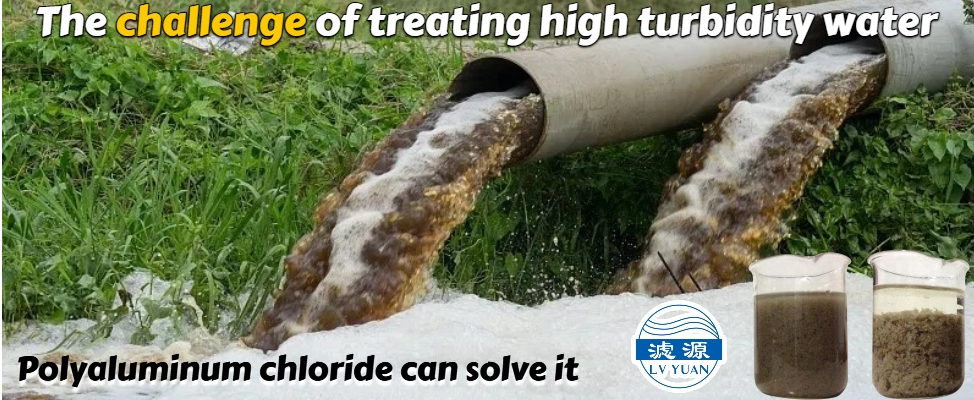
By industry, high turbidity water typically comes from:
⭕Mining and Sand Washing Plants: Rich in fine particles and minerals, turbidity up to thousands of NTU.
⭕Coal Washing Plants: Contain oily, fine coal particles with slow settling rates.
⭕Paper and Food Factories: High in organic colloids and color.
⭕Municipal and Surface Water: Fluctuating turbidity due to rainfall and erosion.
⭕Construction Sites: Suspended solids and concrete residue exceed limits.
● Moderate Turbidity (100–500 NTU): Treatable with PAC + PAM combination.
● High Turbidity (500–3000 NTU): Requires multi-stage dosing or gradient stirring.
● Extreme Turbidity (>3000 NTU): Needs high-efficiency PAC with cationic PAM for better sedimentation and dewatering.
× Unstable or incomplete floc formation
× Cloudy effluent after dosing
× Slow settling and unclear waterline
× High chemical consumption and cost
× Equipment scaling or clogging issues
🌎 Americas:
Mining regions in Chile, Peru, and Colombia face high turbidity (over 2000 NTU) with mineral-rich water. Our high-basicity PAC performs efficiently even at pH 6–9, forming dense flocs and clear water.
🌍 Africa:
In Nigeria, Ghana, and South Africa, industrial wastewater is often oily and organic-rich. Our yellow high-purity PAC, combined with cationic PAM, achieves excellent demulsification and clarification.
🌏 Southeast Asia:
During monsoon seasons, countries like Vietnam and Indonesia face seasonal surges in surface water turbidity. Our spray-dried PAC granules dissolve quickly, ideal for emergency water supply systems.
We provide tailored solutions based on water quality and regional challenges:
1. Custom PAC grades for different pH and impurities
2. PAC + PAM synergy for faster sedimentation
3. Filter-press production for high purity and stability
4. On-site technical guidance for optimal dosing
Performance Results:
√ Up to 90% turbidity reduction
√ 30% faster floc formation
√ Clear and stable discharge
Q1: How much PAC should be used?
Start with 100–200 ppm and adjust based on jar test results.
Q2: Can PAC and PAM be used together?
Yes, dose PAC first for coagulation, then PAM to strengthen flocculation.
Q3: What is the ideal pH range for PAC?
Best performance at pH 5–9.
Q4: How does PAC compare to alum?
Faster flocculation, wider pH adaptability, less sludge, clearer water.
Q5: Is PAC suitable for emergency turbidity control?
Absolutely. PAC reacts fast, forming visible flocs within minutes.
1. Why does the water become turbid after adding PAC?
2.Common problems and solutions of polyaluminum chloride
3.Does the order in which water treatment chemicals are added affect the effectiveness?

Please contact us for free quotation by form below. We promise the quickest response within 24 hours: