
English

Home > Our News > Product Information > What Happens If PAM Dosage Is Too High?
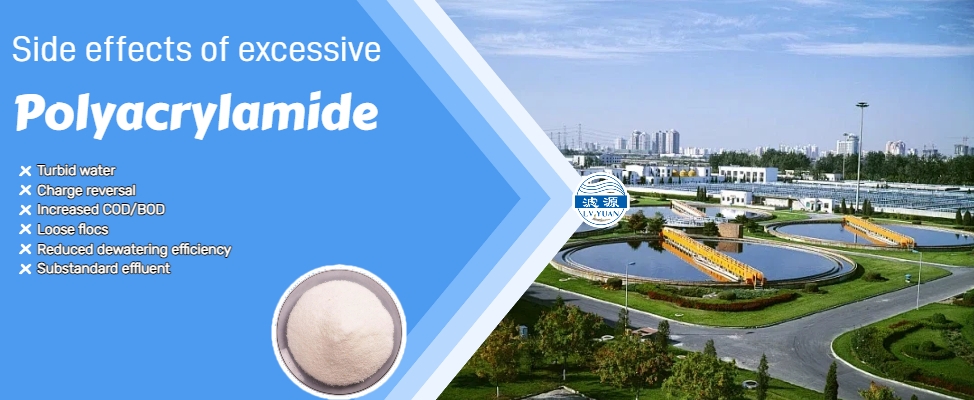
As a professional water treatment chemical manufacturer, we have seen that polyacrylamide (PAM) is one of the most effective yet frequently misused flocculants in wastewater treatment.
PAM works mainly through polymer bridging, connecting small flocs into larger and denser aggregates, improving sedimentation and sludge dewatering performance.
However, more PAM does not mean better results.
When PAM dosage is too high:
● Polymer chains fully coat floc surfaces
● Bridging points are reduced
● Flocs break apart instead of settling
👉 This leads to poor settling and higher turbidity.
In sludge dewatering systems:
● Overdosed PAM creates loose flocs
● Sludge cakes contain higher moisture
● Filter cloths and pipes clog more easily
👉 Operating costs increase instead of decreasing.
PAM is a high-value polymer:
● Excess dosage increases chemical consumption
● Does not improve treatment efficiency
● May negatively affect downstream filtration
There is no universal PAM dosage, but typical reference ranges are:
| Application | PAM Dosage |
|---|---|
| Coal washing wastewater | 1–5 g/m³ |
| Industrial wastewater | 0.5–3 g/m³ |
| Sludge dewatering | 2–6 kg / ton DS |
| Food & slaughterhouse wastewater | 1–4 g/m³ |
👉 Jar tests are strongly recommended before full-scale dosing.
Recommended combination:
● PAC or PFS
● Anionic PAM as flocculant aid
Recommended combination:
● PAC or aluminum sulfate
● Cationic PAM for dewatering
Recommended combination:
● pH adjustment or demulsifier
● PAC + PAM
● Activated carbon if needed
Based on our field experience, we always advise:
● Avoid blindly increasing PAM dosage
● Optimize coagulant selection first
● Choose the correct ionic type of PAM
● Determine the optimal dosage window by testing
Correct PAM dosing means lower cost and stable performance.
Q1: Is overdosed PAM harmful to treated water?
A1: It is not toxic, but it may cause turbidity and COD rebound.
Q2: Can PAM be used alone?
A2: Not recommended. PAM works best with coagulants such as PAC or PFS.
Q3: Why does PAM performance vary so much?
A3: Water quality, pH, mixing, and polymer type all play key roles.

Please contact us for free quotation by form below. We promise the quickest response within 24 hours: