
English
Home > Our News > Company News > Granular PAC and PAM in Thailand
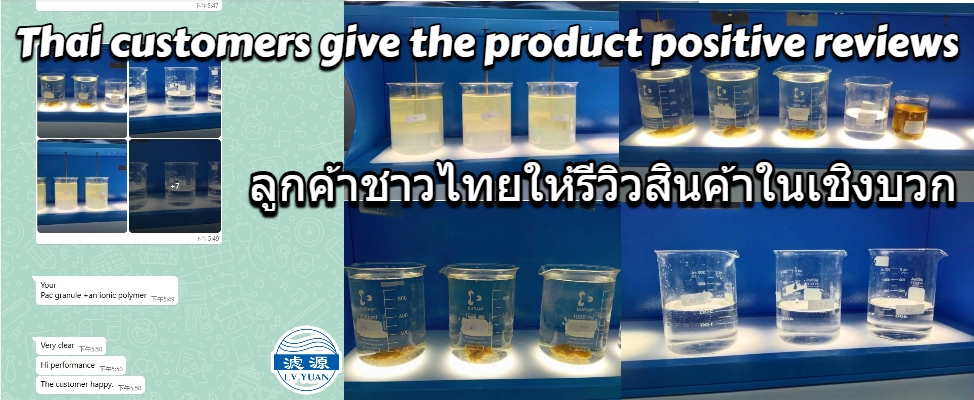
We recently supplied a batch of granular polyaluminum chloride (PAC) and polyacrylamide (PAM) to a client in Thailand for wastewater treatment. After performing sample tests, the client praised our products:
“Fast flocculation, clear sedimentation, and great clarity. Your chemicals work impressively well.”
This feedback reflects both the trusted performance of our products and their suitability for tropical climates like Thailand’s.
Thailand’s high temperature and humidity present challenges for chemical storage and performance. That’s why we recommend choosing granular PAC over powder form.
1. Moisture-resistant, safer for long-term storage
Granular Polyaluminum chloride does not cake easily, even in humid environments.
2. Rapid dissolution and easy handling
Granules dissolve faster and make the dosing process more efficient.
3. High cost-effectiveness
Lower packing and transport costs make granular PAC an economical option.
For optimal treatment results, polyacrylamide (PAM) is commonly used together with PAC:
PAC: Neutralizes and aggregates fine particles
PAM: Strengthens floc structure and accelerates sedimentation
This combination maximizes solid-liquid separation efficiency in industrial wastewater.
Q1: Why is granular PAC better for tropical regions?
A: Granular PAC is more resistant to moisture, stays stable, and avoids caking compared to powder PAC.
Q2: Can you recommend the right PAM grade for our wastewater?
A: Yes, we offer anionic, cationic, and nonionic PAM based on water composition and pH.
Q3: Do you ship directly to Thailand?
A: Yes, we ship directly from China via sea or air, ensuring stable supply and competitive cost.
Q4: What is the ideal PAC to PAM ratio?
A: We can advise based on a detailed water analysis. Free consultation is available.
Q5: Can we request customized packaging with our logo?
A: Yes, custom bags such as 25kg sacks or jumbo bags with private label printing are available.
1.How should PAC and PAM be used together?
2.What are the differences between PAC and PAM? How to choose between them?
3.How to store correctly? What problems can improper storage cause?

Please contact us for free quotation by form below. We promise the quickest response within 24 hours: