
English

Home > Our News > Product Information > What is Non-ionic Polyacrylamide?
As a professional water treatment materials manufacturer, we focus on high-quality polyacrylamide (PAM) production and research. Among PAM products, non-ionic polyacrylamide (NPAM) is a key flocculant. “Non-ionic” means its molecules carry no positive or negative charges, making it uniquely effective in certain water conditions.
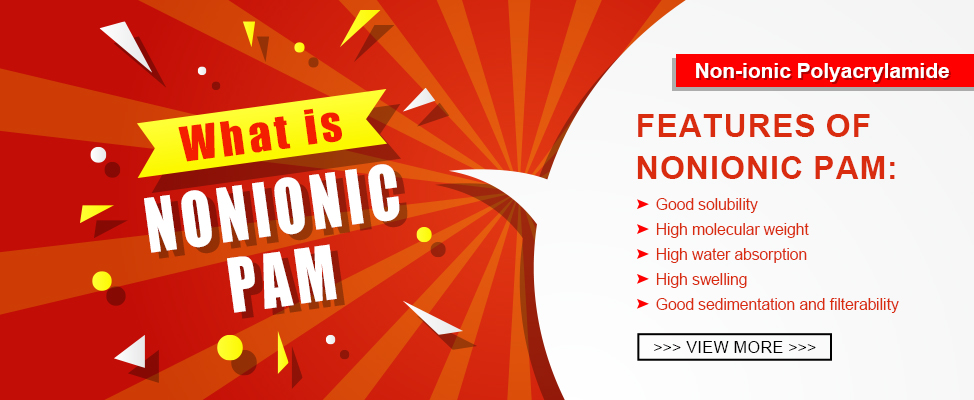
Non-ionic PAM molecules do not contain cationic or anionic groups, so they do not rely on charge neutralization. NPAM works through molecular adsorption and bridging to aggregate suspended particles for solid-liquid separation.
Assists flocculation when charge is low
Effective for neutral or low-charge suspended particles, improving settling and separation efficiency.
Enhances sludge dewatering
NPAM increases floc porosity, allowing easier water release and lower residual moisture.
Reduces secondary pollution
Less reliance on charge neutralization decreases chemical consumption and residual generation.
● Textile wastewater: Neutral or low-charge fibers and dyes.
● Paper mill wastewater: Improves settling of pulp suspension.
● Food processing wastewater: High organic content, low charged particles.
● Neutral or slightly acidic/basic wastewater: Avoids interference from charges and improves stability.
● Too low: Weak flocs, slow settling, poor separation.
● Too high: Dense flocs, reduced flow, higher mixing energy and chemical costs.
● Optimal dose: Determine via small-scale jar tests based on water quality.
● Incomplete settling → insufficient NPAM or water quality changes
● Foamy or fragile flocs → excessive NPAM or poor mixing
● Low dewatering efficiency → combine with PAC or CPAM, adjust dosing sequence
Q1: What is the difference between non-ionic and cationic PAM?
A1: NPAM carries no charge and relies on adsorption and bridging; CPAM carries positive charge, suitable for neutral or negatively charged particles.
Q2: How to determine NPAM dosage?
A2: Conduct jar tests based on water characteristics to find the optimal dose.
Q3: Can NPAM be combined with other chemicals?
A3: Yes, commonly combined with PAC or CPAM to improve flocculation and sludge dewatering.
Q4: Which industries benefit most from NPAM?
A4: Textile wastewater, paper mill wastewater, food processing wastewater, and neutral or slightly acidic/basic wastewater.

Please contact us for free quotation by form below. We promise the quickest response within 24 hours: