
English

Home > Our News > Product Information > What is Cationicity in Cationic Polyacrylamide?
As a professional water treatment chemical manufacturer in China, we supply Polyacrylamide (PAM), PAC, Calcium Chloride, Activated Carbon, Ferric Sulfate, PFS, PolyDADMAC, ACH, and many other industrial chemicals. Among them, Cationic Polyacrylamide (CPAM) is widely used in municipal wastewater, sludge dewatering, papermaking, food processing, and chemical industries.
Customers often ask us:
“What does cationic degree mean?”
“How do I choose the right cationic polyacrylamide?”
“What happens if the cationic degree is incorrect?”
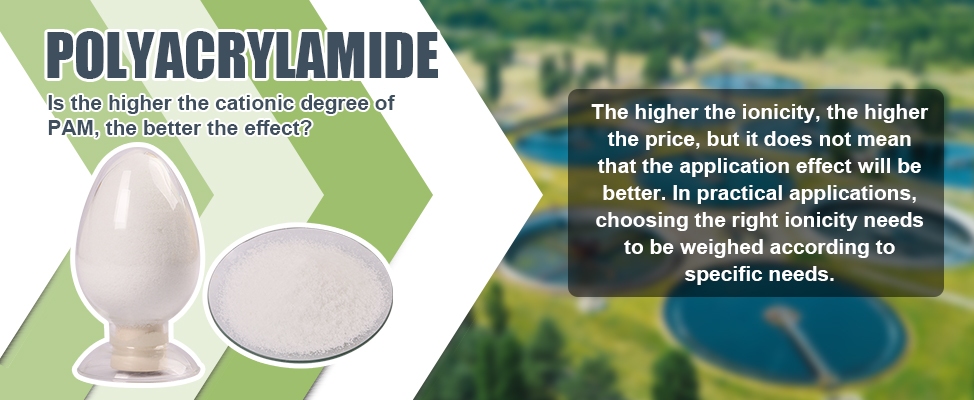
The cationic degree refers to the proportion of positively charged functional groups in the polymer chain.
These cationic groups help:
⚪ Neutralize negatively charged sludge
⚪ Improve floc formation
⚪ Speed up sedimentation
⚪ Enhance sludge dewatering
⚪ Produce drier, stronger filter cakes
We manufacture CPAM with cationic degrees ranging from:➡ 5% to 95%
Higher cationic degree = more positive charge = suitable for wastewater with stronger negative charges.
Based on thousands of tests we conducted for clients, here are general guidelines:
● Municipal sludge-✔ 20%–40%
● Papermaking sludge-✔ 30%–50%
● Food processing wastewater-✔ 15%–30%
● Chemical wastewater (high COD)-✔ 40%–60%
● Oily wastewater-✔ 10%–20%
📌 The best solution is always jar testing before final selection.
If the cationic degree is too low
● Weak flocs
● Slow sedimentation
● High moisture sludge
● More chemical consumption
➡ Result: high treatment cost
If the cationic degree is too high
● Flocs become brittle
● Break apart easily
● Effluent becomes turbid
● Filter cloth blockage
➡ Result: poor treatment performance
Chemical waste and poor efficiency
● Double dosage
● Longer filter-press cycle
● Difficult compliance with discharge standards
● More sludge volume
Q1: Is a higher cationic degree always better?
A1: No. It must match the sludge’s negative charge level.
Q2: How do I know the correct cationic degree?
A2: A jar test is required to observe floc size, settling speed, and supernatant clarity.
Q3: Can CPAM be used together with PAC?
A3: Yes. Many industries achieve better results using CPAM and PAC together.

Please contact us for free quotation by form below. We promise the quickest response within 24 hours: