
English

Home > Our News > Product Information > Iodine Number in Activated Carbon
As a water treatment materials manufacturer with 28 years of experience, we supply various activated carbon products to global customers, including coconut shell carbon, coal-based granular carbon, powdered carbon, and regenerated carbon. One of the most frequently asked questions is:
What is iodine value, and why is it important? What iodine range should each industry use?
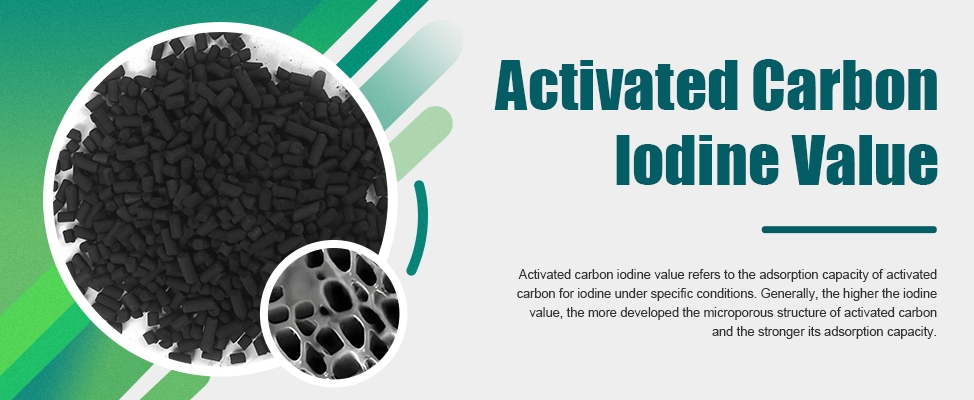
The iodine value (IV) is the most widely used international indicator of activated carbon performance.
A higher iodine value means more micropores and stronger adsorption capacity.
More micropores → Better removal of small organic molecules, COD, odor, and color.
| Type | Iodine Value Range | Notes |
|---|---|---|
| Coconut Shell Activated Carbon | 900–1300 mg/g | Excellent for high-end water purification |
| Coal-Based Granular Activated Carbon | 600–1000 mg/g | Strong durability, ideal for industrial wastewater |
| Powdered Activated Carbon | 500–900 mg/g | Used for decolorization and COD reduction |
| Regenerated Carbon | 500–800 mg/g | Depends on regeneration quality |
Adsorption Efficiency : Higher iodine → Faster adsorption.
Adsorption Capacity: Higher iodine → Longer service life and lower operational cost.
Industry Suitability: Different wastewater types require different iodine ranges.
● Drinking Water & Food Industry : Recommended: 900–1200 mg/g (coconut shell)
● Chemical & Industrial Wastewater :Recommended: 800–1000 mg/g (coal-based granular)
● Decolorization (MSG, pharmaceutical, food) : Recommended: 700–900 mg/g (powdered carbon)
● Electroplating & Metal Industry :Recommended: ≥1000 mg/g high iodine carbon
● General Industrial & Circulating Water : Recommended: 600–800 mg/g (coal-based granular)
Regenerated carbon typically has an iodine value 10–30% lower than new carbon.
✔ Suitable for general industrial wastewater
✘ Not suitable for high-purity applications (drinking water, electronics, food grade)
We provide iodine value test reports to ensure performance transparency.
Q1: Is a higher iodine value always better?
Not necessarily. It depends on your industry and required purification level.
Q2: What happens if the iodine value is too low?
Slower adsorption and shorter lifespan.
Q3: Can regenerated activated carbon replace new carbon?
Yes for general wastewater; no for high-end applications.
Q4: What’s the difference between iodine value and methylene blue (MB) value?
Iodine measures micropore adsorption; MB measures mesopore adsorption.

Please contact us for free quotation by form below. We promise the quickest response within 24 hours: